As an Amazon Associate we earn from qualifying purchases. Prices and availability are shown on Amazon, not here.
Key takeaways
- Size by cubic metres, not square metres. The area printed on the box assumes a ceiling height. Measure length by width by height and match it to the CADR figure.
- Look for a declared filter class. H13 is a grade under EN 1822 and means something; "True HEPA" on its own doesn't, and the class describes the filter media, not the sealed machine. "HEPA-type" or "HEPA-style" is a marketing word with nothing behind it.
- Filters are the real running cost. Check the replacement is sold on Amazon UK, and how often the manual says to change it, before you buy the machine.
- Judge the noise in the mode you will actually use. The quoted decibel figure is usually the lowest fan speed, which often does not clean the room fast enough to matter.
- Skip ionisers and anything that generates ozone. Filtration is the part that works. Ozone is an irritant, not a feature.
- It is for particles: dust, pollen, smoke, pet dander. It does not dry out damp, remove mould from a wall, or replace an extractor fan or an open window.
Air purifiers are sold as a fix for everything: allergies, smells, stuffiness, damp, that vague sense the house is not quite clean. They are not. They are a fan and a filter. What they do, they do well, and what they do is remove particles from the air that passes through them. Dust, pollen, smoke, pet dander. That is the list.
Everything else on the box is either a side effect or a claim you should ignore. This guide covers the four things that decide whether the one you buy is any use: the sum that matches output to room volume, the filter grade, what the replacements cost you over the years, and how loud it is in the mode you will actually leave it in overnight.
TL;DR
- One bedroom: Levoit Core 300S. Declared H13 filter, small footprint, quiet enough on its lowest setting to sleep next to.
- Living room: Levoit Core 400S. More capacity means a lower fan speed for the same result.
- Pets: Levoit Vital 200S, for dander and hair.
- Pollen season: Philips Series 2000i, for the sensor and the readable display.
- Open plan: Shark NeverChange5 Air Purifier, for the airflow.
- Skip: anything selling an ioniser, a plasma generator or "active oxygen" as the main event.
What it is for, and what it is not for
It is for airborne particles. Pollen coming in through an open window in June. House dust stirred up by hoovering. Pet dander, which is what purifiers sold for pet homes are aimed at. Smoke from a nearby fire or a wood burner. In a closed room, a correctly sized H13 unit will thin those out.
It is not for damp. Humidity is water vapour, not a particle, and a HEPA filter does nothing to it. It is not for mould growing on a wall, which is a surface problem: you clean it, you fix why the wall is wet, and you ventilate. A purifier may catch some spores in the air, but the colony stays where it is.
It is not a substitute for an extractor. Frying in a kitchen with no extraction produces grease and fumes faster than a domestic purifier can process them, and the grease will clog the filter you paid for. Open the window and use the hob extractor, or fit a proper cooker hood extractor if the kitchen has none.
And it does not replace ventilation. A purifier recirculates. It does not bring in fresh air, remove carbon dioxide or fix a stuffy room. Open the window anyway.
The sum: CADR against your room's cubic metres
The number that matters is CADR, the Clean Air Delivery Rate, usually given in cubic metres per hour. It is the volume of filtered air the machine actually delivers, which is not the same as the fan's raw airflow.
The box will quote a room size in square metres. That figure hides an assumption about ceiling height, usually a low one. British housing stock is not uniform: a Victorian front room and a new-build bedroom with the same floor area can differ by a third in volume.
So measure the volume. Length times width times height, in metres. Then decide how many times an hour you want the air changed. Two turns an hour is a background setting. Four to five is what you want if the point is pollen or smoke.
| Room | Rough volume | CADR for 2 changes/hour | CADR for 5 changes/hour |
|---|---|---|---|
| Small bedroom, 3 x 3 x 2.4 m | ~22 m3 | ~44 m3/h | ~110 m3/h |
| Double bedroom, 4 x 3.5 x 2.4 m | ~34 m3 | ~68 m3/h | ~170 m3/h |
| Living room, 5 x 4 x 2.4 m | ~48 m3 | ~96 m3/h | ~240 m3/h |
| Victorian room, 5 x 4 x 3 m | ~60 m3 | ~120 m3/h | ~300 m3/h |
| Open plan, 8 x 5 x 2.5 m | ~100 m3 | ~200 m3/h | ~500 m3/h |
Compare that last column against the CADR on the listing. If the machine only meets it at maximum fan speed, you have found your answer about noise before you have bought anything.
Filters: a declared class, or nothing
HEPA is a standard with grades. H13 is the one commonly declared on domestic units, and a listing that states it is telling you something specific about what the filter captures.
"HEPA-type", "HEPA-style" and "HEPA-like" are not grades. They are words chosen to sit next to the real one. If the listing will not name a class, assume there isn't one.
Most units stack three stages: a pre-filter for hair and large dust, the HEPA layer for fine particles, and activated carbon for odours and some gases. The carbon is the part that saturates quietly. It does not look used when it has stopped working.
Now the part nobody budgets for. Before you buy the machine, look up the replacement filter for that exact model and check three things: that it exists, that it is sold by the brand rather than only by third parties, and how often the manual says to change it. Six to twelve months is typical. Over five years that is a recurring purchase, and on some machines it adds up to more than the unit itself. A purifier with no available filter is a fan.
Noise: judge the mode you will actually run
The decibel figure on a product page is almost always the lowest fan speed. That setting frequently does not deliver the air changes your room needs, so it is a number describing a mode you will not use.
The useful question is how loud it is at the speed that meets your CADR target. This is the strongest argument for buying a unit with more capacity than the room strictly requires: it hits the same result on speed one or two instead of speed four.
For a bedroom, look for a unit with a genuine night mode, and check whether the display lights can be turned off. A bright blue air-quality ring is a real problem at two in the morning.
Ionisers and ozone: the part to switch off
Some units add an ioniser, a plasma stage or something described as active oxygen. These charge or react with particles rather than trapping them, and some of them produce ozone as a by-product. Ozone is a respiratory irritant. It is not a cleaning agent you want in a closed bedroom.
Filtration is the mechanism that works and the one you can verify. If a machine has an ioniser, look for the switch that disables it. If the ioniser is the main selling point and there is no meaningful filter behind it, buy something else.
Things the box doesn't tell you
- The square-metre rating assumes a ceiling height you did not choose. Do the cubic-metre sum yourself.
- One unit cleans one room. It will not treat a whole flat through open doorways. Put it where you spend the hours, usually the bedroom.
- A purifier in a room with the window open is mostly filtering the street. Ventilate, then close up and run it.
- The smart app is not the product. A scheduler and a filter-life counter are handy, but the filter and the fan do the work. If you are building out a connected house, our Best UK Smart Home Starter Kit 2026 guide covers where app control genuinely earns its place.
- Carbon filters saturate invisibly. The smell coming back is the indicator, not the appearance of the filter, so keep a spare activated carbon filter in the cupboard.
Where it is worth the money
If your problem is airborne particles in one room, a correctly sized purifier with a declared H13 filter is a sensible purchase, and the sizing sum is most of the decision. If your problem is damp, mould, cooking fumes or a stuffy house, the purifier is the wrong tool and the money is better spent on a dehumidifier sized for the room, an extractor or fixing the ventilation.
Work out the room volume, pick a unit whose CADR clears it several times an hour without running flat out, confirm the replacement filter is on sale, and turn the ioniser off. Those four checks are the decision. And if breathing problems persist, see a doctor rather than a product listing.
Our picks
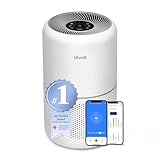
Levoit Core 300S
Levoit
Compact three-stage unit with a declared H13 True HEPA filter and a sleep mode. Sized for a single bedroom. Not for you if the room is an open-plan living space, where it will run flat out and still be undersized.
£149.99 Retrieved on 01/10/2026 · prices subject to change
Levoit Core 400S
Levoit
The bigger sibling, with a higher CADR so it can clear a living room at a lower fan speed. Not for you if it is going in a small bedroom: you are paying for capacity you cannot use quietly.
Levoit Vital 200S
Levoit
Wider intake and a pet-oriented filter option aimed at dander and hair. Not for you if your problem is a smell coming from a litter tray or a bin: a filter thins airborne particles, it does not remove the source.
Philips Series 2000i
Philips
Sensor-driven auto mode with an allergen setting and a readable particle display, which helps you see whether the thing is doing anything. Not for you if you want silent running: auto mode will ramp up when it detects particles, including at night.
Shark NeverChange5 Air Purifier
Shark
Higher airflow aimed at bigger volumes, with a filter designed for long service intervals. Not for you if you want the cheapest possible unit for one small room, or if you need it tucked into a tight corner.
Levoit Core 300 Replacement Filter
Levoit
The consumable for the Core 300 line, sold directly on Amazon UK. Worth checking the equivalent exists for whichever model you pick. Not for you if you bought a different machine: filters are not interchangeable between brands or even between ranges.
On ThePriceMonkey
Products from this guide in our catalogue — current price, specs and availability on each page.
- Levoit Core 300S · Levoit