As an Amazon Associate we earn from qualifying purchases. Prices and availability are shown on Amazon, not here.
Key takeaways
- The real test: can you buy every ingredient in one normal UK supermarket shop? A book that sends you hunting specialist ingredients gets opened twice and then shelved.
- Exact beats evocative: grams, minutes and oven temperatures make a recipe repeatable. "A glug", "a knob", "until it looks right" are fine for a confident cook and useless for everyone else.
- Four types, not one: weeknight recipe collection, technique and reference book, single-appliance book, and illustrated gift book. They fail for completely different reasons.
- Layout is a feature: one recipe per page, method in numbered steps, no recipe split across a gutter. You read it standing up with wet hands, not sitting down.
- Technique books are not recipe books: they teach why things work and give few recipes. Excellent second book, frustrating first one.
- Skip: anything bought because the photography is beautiful, unless you already know you want that cuisine on a Tuesday.
Most cookbooks are flicked through twice and then live on a shelf. That is not a failure of the cook. It is usually a mismatch between the book and the kitchen it landed in.
What decides whether a cookbook gets used is dull stuff you can check in a sample page: whether the recipes are written for a British weeknight and a British supermarket, whether quantities and times are exact, whether the layout survives messy hands, and whether the book is teaching technique or handing you recipes. None of that is on the cover. All of it is visible in the sample pages.
TL;DR
- Best for a British weeknight: The Roasting Tin. One tin, one oven, supermarket ingredients.
- Best short shopping list: Jamie's 5 Ingredients. Five items is the reason it gets cooked.
- Best technique book: Salt Fat Acid Heat. A second book, not a first one.
- Best reference: The Flavour Thesaurus. Consulted, not followed.
- Best single-appliance option: an air fryer cookbook, chosen by checking the sample pages rather than the author.
The four types of cookbook
Almost every cookbook on Amazon UK is one of four things. They are sold identically and they fail differently.
The weeknight recipe collection. Short ingredient lists, one method, exact grams and minutes. It succeeds or fails on the shopping list. If two recipes in a row need something you have to go and find, the book stops being used.
The technique or reference book. Teaches principles, gives few finished recipes. It is the book that makes every other book work better, and it is a poor choice for someone who wants dinner rather than an education.
The single-appliance book. Written for an air fryer, a slow cooker, a pressure cooker. Genuinely useful if you use the machine, because the hard part of those appliances is knowing times and temperatures. Dead weight otherwise. If you are still choosing the machine, start with the air fryer buying guide and buy the book after. The same test applies to slow cooker recipe books, where our slow cooker guide covers picking the machine first, and to pressure cooker recipe books: check the timings are written for the machine you own.
The illustrated gift book. Large format, full-page photography, often a restaurant or a region. Some of the large illustrated cookbooks sold as gifts are excellent. Many are bought for the cover and cooked from twice. The giveaway is a recipe running across a two-page spread with the method in a single dense paragraph: nobody reads that standing at a hob.
The Roasting Tin
Rukmini Iyer, published by Square Peg. The format is the whole idea: ingredients go in a roasting tin, the tin goes in the oven, you do something else for forty minutes. The only kit it assumes is a deep roasting tin that fits your oven. Quantities are in grams, oven temperatures and times are stated, and the ingredients are ordinary UK supermarket stock. One recipe per page.
It teaches you almost nothing about cooking, on purpose. If you want to get better rather than get fed, this is not the book.
Jamie's 5 Ingredients
Jamie Oliver, published by Michael Joseph. Every recipe is capped at five ingredients, not counting salt, pepper and oil. That cap is the single most effective weeknight feature a cookbook can have, because the reason a recipe does not get made is usually the shop, not the cooking.
The trade-off is range. Within any one cuisine the recipes stay shallow, and a confident cook will find them thin; the rest of Jamie Oliver's back catalogue goes deeper for the same weeknight audience.
Ottolenghi Simple
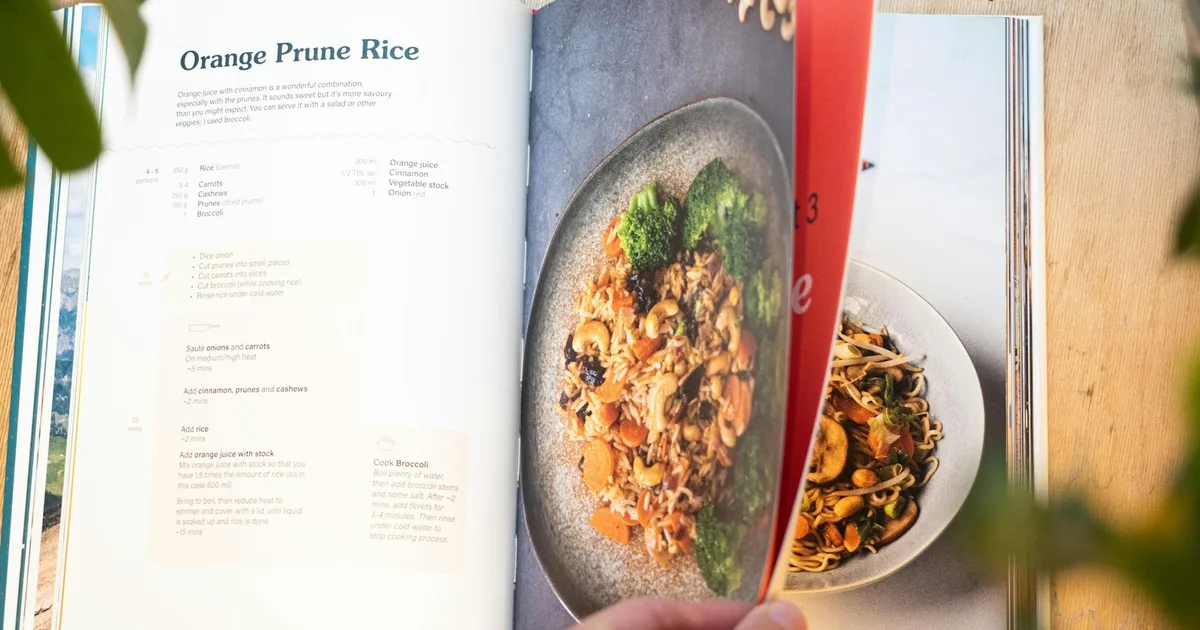
Yotam Ottolenghi, published by Ebury Press. Vegetable-led, tagged by effort, with a subset of recipes that need only store-cupboard items. Quantities are exact and the writing is precise. Check the sample pages of the current UK edition before you commit.
Be honest about the pantry. "Simple" here assumes a cupboard that already contains a handful of things a typical UK kitchen does not, so the first shop is the expensive one in time, not the later ones. If that first shop is a barrier, start elsewhere.
Salt Fat Acid Heat
Samin Nosrat, published in the UK by Canongate. Organised around four variables rather than around dishes, illustrated rather than photographed, with the recipes gathered in the second half. It explains why seasoning works, not just when to do it.
It is a reading book. As a first cookbook it frustrates, because you cannot open it at random and be cooking five minutes later. Someone at that stage is better served by a straightforward beginner's cookbook and can come back to this one later.
The Flavour Thesaurus
Niki Segnit, published by Bloomsbury. It pairs ingredients and discusses which combinations work and why. There are very few complete recipes in it.
Bought as a cookbook, it disappoints. Bought as a reference for someone who already improvises, it gets pulled off the shelf more often than most cookbooks.
Air fryer cookbook
This one is a category, not a title, and it is better treated that way. Search it and judge the sample pages on three points: temperatures in Celsius, times given with a stated basket size, and ingredients from a UK shop. A book converted from a US edition will fail at least one of those.
Only worth it if the appliance is already in weekly use.
Comparison
| Book | Type | Weeknight? | Teaches technique? |
|---|---|---|---|
| The Roasting Tin | Recipe collection | Yes | No |
| Jamie's 5 Ingredients | Recipe collection | Yes | Minimal |
| Ottolenghi Simple | Recipe collection | Partly | Some |
| Salt Fat Acid Heat | Technique | No | Yes |
| The Flavour Thesaurus | Reference | No | Indirectly |
| Air fryer cookbook | Single appliance | Yes | No |
Things the blurb doesn't tell you
- US editions leak through. Cup measurements, Fahrenheit, and ingredient names that do not match UK labels. Check the sample pages for grams and Celsius before buying.
- Vague quantities are a style, not a shortcut. "A glug of oil" reads well and cannot be repeated by someone who has not cooked the dish before.
- Binding matters more than it sounds. A book that will not stay open on a worktop gets used less than one that will, which is why spiral-bound and lay-flat cookbooks are worth seeking out.
- A recipe split across a page turn is a design failure. You will notice it every single time you cook it.
- Photography count is not recipe count. A big book can hold fewer recipes than a small one, and the page count on the listing does not distinguish.
- The index is a usability feature. An index by ingredient, not just by dish name, is what turns a book into something you use when there is chicken in the fridge.
The short version
Decide which of the four types you are buying before you look at covers. Then open the sample pages and check the shopping list, the units and the layout. Those three checks predict whether a cookbook gets used better than any description on the back.
Our picks

The Roasting Tin
Rukmini Iyer, Square Peg
One-tin recipes: everything goes in a roasting tin and into the oven. Ingredients are standard UK supermarket stock, quantities are in grams, times and temperatures are given. Layout is one recipe per page. Not for you if you want to learn knife skills or build a repertoire of techniques, because it deliberately teaches almost nothing.
£17.99 Retrieved on 30/09/2026 · prices subject to change

Jamie's 5 Ingredients
Jamie Oliver, Michael Joseph
Every recipe caps the shopping list at five ingredients, which is the single biggest reason a midweek recipe actually gets made. Written for UK shops and UK ovens. Not for you if you want depth or variety within a cuisine, because the constraint flattens a lot of the detail.
£18.00 Retrieved on 30/09/2026 · prices subject to change
Ottolenghi Simple
Yotam Ottolenghi, Ebury Press
A vegetable-forward collection tagged by how much effort each recipe needs, including a short pantry-only set. Quantities are exact. Honest caveat: "simple" here still means a few store-cupboard items you may not own yet, so the first shop is bigger than the rest. Not for you if you want everything in the trolley on a Tuesday evening.
£20.00 Retrieved on 30/09/2026 · prices subject to change

Salt Fat Acid Heat
Samin Nosrat, Canongate
A book about why food tastes good, organised around four variables, with recipes in the back half rather than throughout. Illustrated, not photographed. Not for you as a first cookbook, or if you want to open it at 7pm and be cooking by 7:05. It rewards reading, not scanning.
£27.45 Retrieved on 30/09/2026 · prices subject to change

The Flavour Thesaurus
Niki Segnit, Bloomsbury
Pairs ingredients against each other and explains which combinations work. Essentially a reference volume: you consult it, you do not follow it. There are very few full recipes. Not for you if you want dinner tonight, and it will disappoint anyone who bought it expecting a cookbook.
£15.00 Retrieved on 30/09/2026 · prices subject to change

Air fryer cookbook
Search by appliance, not by author
A whole category rather than one title, and the right approach is to search it and check the sample pages. What matters: temperatures in Celsius, times given per basket size, and UK ingredients. Not for you if you do not already own and use the appliance weekly, because an appliance book has no life outside it.
£98.58 Retrieved on 30/09/2026 · prices subject to change
On ThePriceMonkey
Products from this guide in our catalogue — current price, specs and availability on each page.
- The Roasting Tin · Square Peg
- Jamie's 5 Ingredients · Michael Joseph
- Ottolenghi Simple · Ebury Press
- Salt Fat Acid Heat · Canongate
- The Flavour Thesaurus · Bloomsbury
- Air fryer cookbook · Cosori