As an Amazon Associate we earn from qualifying purchases. Prices and availability are shown on Amazon, not here.
Key takeaways
- The litres on the box are the bowl, not the meal. Manufacturers tell you to fill between a half and two thirds, so usable volume is roughly two thirds of the headline number.
- A hob-safe pot saves a pan. If the inner pot goes on the hob, you brown meat and onions in it and then drop it into the base. If it does not, browning means a frying pan to wash.
- A dial is not a timer. Low, High and Auto with no clock means the cooker runs until you switch it off. A timer with auto-warm is the difference between dinner and a dried-out pot.
- Check the pot is dishwasher-safe and liftable. A full ceramic pot is heavy and awkward at the sink; some lids and pots are hand-wash only.
- Running cost is the point. A slow cooker is a low-wattage appliance left on for hours, which is the opposite of heating a whole oven for one dish.
- It is bad at texture. No browning, no crisping, no crust, and anything delicate turns to mush. It is a braising machine, nothing more.
Slow cookers are one of the few kitchen appliances where the cheap one and the expensive one cook the same. The job is holding a pot between roughly 80 and 95 degrees for hours, and every model on Amazon UK does that. What separates them is the pot, the controls, and whether the number on the box means anything.
It usually does not. The litres printed on the front are the volume of the empty bowl. Every manual then tells you to fill it between a half and two thirds, because a slow cooker works by condensing steam on the lid and dropping it back in, and an over-filled pot has nowhere for that to happen. So a cooker sold as a certain size holds about two thirds of that in food.
TL;DR
- The default: Crock-Pot. Ceramic pot, easy to find, does the job.
- If you hate washing a second pan: Morphy Richards Sear and Stew. The inner pot goes on the hob.
- Cheapest sensible route: Russell Hobbs, dial only. Fine if you are home to switch it off.
- One or two people: Salter compact. A big cooker run half empty cooks worse, not better.
- Skip: anything selling a long list of modes. Slow cooking is two temperatures and a clock.
The size on the box is the bowl, not the meal
Buy by portions and ignore the marketing. A rough way to read a listing: take the litres, take two thirds of it, and assume roughly half a litre of finished stew per adult portion. That puts most family-sized cookers at four to five real portions, not the six or seven implied.
The under-filling side matters too, and nobody prints it on the box. Below about half full, the food sits in a shallow layer against a hot wall and dries at the edges while the middle is fine. This is why a large cooker is a bad buy for one person. If you cook for one or two most of the time and batch cook occasionally, a compact slow cooker plus two runs beats the big cooker run half empty.
Hob-safe pot, or a pan to wash
Almost every slow cooker recipe worth eating starts with browning. Meat and onions that go in raw give you grey meat in thin liquid; browned ones give you the colour and depth people associate with a stew. The question is where that browning happens.
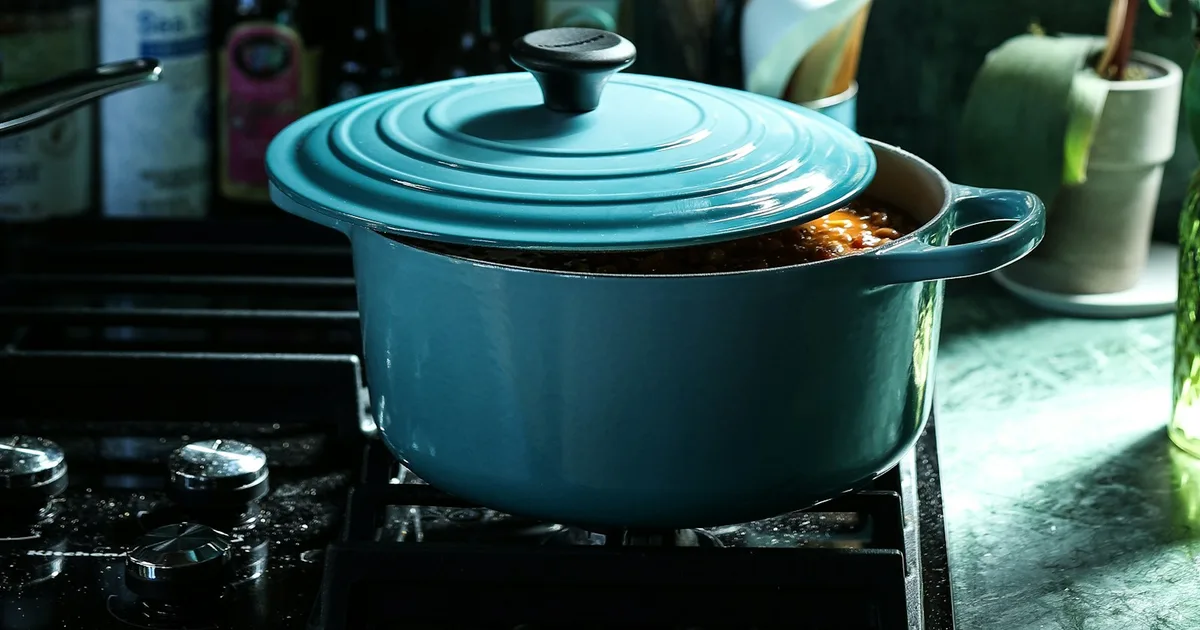
Stoneware crocks cannot go on a hob; metal pots, including ceramic-coated ones, can. Stoneware is heavy, it holds heat well, it looks fine on a table, and it means a frying pan in the sink every time you cook. The aluminium and coated metal pots in a hob-safe slow cooker go straight on the ring, so you brown, deglaze, and lower the whole thing into the base. One pot, one wash.
The trade is real in both directions. Metal pots are lighter to lift and easier at the sink; stoneware is more scratch-tolerant and holds heat longer once it comes off. Decide which annoyance you would rather have every week.
A timer with auto-warm, or just a dial
A dial model has Low, High, and usually Keep Warm as a position you select by hand. It runs until a human intervenes. That is fine for a weekend, and it is the wrong appliance for a workday, because eight hours becomes ten and the pot is dry.
A slow cooker with a digital timer lets you set a time and drops to keep-warm automatically when it ends. That is the one thing in this category genuinely worth paying for. Two things to check in the listing: whether keep-warm is automatic or just another manual setting, and whether the cooker has a delay start, which food safety advice generally argues against for raw meat left sitting at room temperature.
Crock-Pot Slow Cooker
The category reference. Stoneware pot, glass lid, available in basic dial and digital timer versions, and easy to find replacement ceramic bowls for. If you want the ordinary thing that ordinary recipes assume, this is it. On the basic models the stoneware crock is the limitation: no hob browning, and a full one is heavy to lift. If that is the deciding factor, Crock-Pot also sells the DuraCeramic Saute and the Sizzle and Stew ranges, whose metal pots do go on a ring.
Morphy Richards Sear and Stew
Built around the hob-safe pot, which is the single design decision that changes how the appliance feels to use. Lighter than ceramic, which also makes washing up easier. You give up the heat retention of a thick ceramic bowl, and coated metal wants a plastic or wooden spoon.
Russell Hobbs Slow Cooker
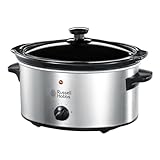
Dial, three positions, done. Cooking quality is not where the money goes in this category, so a plain dial-only model produces the same stew as a dearer one. Buy it if someone is home at the end of the cook. If not, the lack of an auto-warm is not a small thing.
Salter Slow Cooker
A compact body for one or two portions, and for worktops that are already full. Small cookers are easier to store and easier to lift, and they solve the under-filling problem that makes a big cooker a poor buy for a small household. Not a batch-cooking machine.
Ninja Foodi PossibleCooker
A wide multi-cooker pan with its own element: sear in it, slow cook in it, finish it in the oven, serve from it. Fewer transfers and fewer pans, at the cost of worktop space and a higher price than a plain cooker. Sensible if you would use the searing and the oven-safe pot; overkill if you would not.
Instant Pot Duo
Primarily a pressure cooker with slow cook and saute modes. Worth considering when the constraint is space and you want fast and slow in one box. Slow cooking is the weakest thing it does, so treat it as a pressure cooker that can also slow cook rather than the reverse.
| Model | Pot | Hob-safe | Controls | Best for |
|---|---|---|---|---|
| Crock-Pot | Stoneware, metal on Saute models | No on the basic models; yes on Saute and Sizzle and Stew | Dial or digital | The standard choice |
| Morphy Richards Sear and Stew | Metal | Yes | Dial or digital | Browning without a second pan |
| Russell Hobbs | Stoneware | No | Dial | Cheapest sensible option |
| Salter compact | Stoneware | No | Dial | One or two people |
| Ninja Foodi PossibleCooker | Metal, oven-safe | Sear in the unit | Digital | One pan for everything |
| Instant Pot Duo | Stainless | Saute in base | Digital | Pressure cooking first |
Things the box doesn't tell you
- Washing up. Check the listing for dishwasher-safe pot and lid. Some are hand-wash only, and a full-size ceramic bowl is awkward in a UK dishwasher even when it is allowed.
- Weight. A ceramic pot with a stew in it is heavy. It matters if you have wrist or grip problems, and nobody mentions it.
- The lid. Glass lets you look without lifting. Lifting the lid vents the steam that does the cooking and adds time.
- Worktop footprint. These are wide, and they stay out. Measure before buying, including height under wall cupboards.
- What it cannot do. No crisping, no browning once the lid is on, no crust. Fish, greens and pasta overcook. Dairy splits unless added at the end. If you want crisp, that is a different appliance: see our air fryer guide.
A slow cooker is a narrow tool that does one thing well and several things badly. The useful decisions are small: match the capacity to the number of people actually eating, decide whether you will brown in the pot or in a pan, and get an automatic keep-warm if you will not be home. Everything else on the spec sheet is noise. If you are kitting out a kitchen from scratch, the same logic applies to the kettle: buy the feature you will use, ignore the mode list. And if what is missing is things to cook in it, our cookbook guide covers how to tell a slow cooker book written for a British shop from one that is not.
Our picks

Crock-Pot Slow Cooker
Crock-Pot
The reference point for the category and the easiest to find spares and recipes for. Stoneware pot, simple controls on the cheaper versions, digital timer on the dearer ones. Not for you if you want to brown in the pot on a basic model: the stoneware crock does not go on a hob, though the Saute and the Sizzle and Stew ranges swap it for a hob-safe metal one.
£32.50 Retrieved on 30/09/2026 · prices subject to change

Morphy Richards Sear and Stew
Morphy Richards
Built around a light hob-safe inner pot, so searing and stewing happen in one piece of metal and there is no frying pan to wash. Not for you if you want a heavy ceramic bowl that holds heat on the table, or if you never brown anything anyway.
£47.99 Retrieved on 30/09/2026 · prices subject to change
Russell Hobbs Slow Cooker
Russell Hobbs
Low, High, Keep Warm and nothing else. It does the actual cooking as well as anything dearer, because the job is holding a low temperature for hours. Not for you if you leave the house for a ten-hour day and need the cooker to stop on its own.
£36.95 Retrieved on 30/09/2026 · prices subject to change

Salter Slow Cooker
Salter
A compact body that fits on a crowded worktop and in a normal cupboard. Sensible when you are cooking for one or two, because a big cooker run half empty cooks badly. Not for you if you batch cook for the freezer: you will be running it twice.
£39.99 Retrieved on 30/09/2026 · prices subject to change

Ninja Foodi PossibleCooker
Ninja
A large pan with its own heating element: sear, slow cook, then straight to the table, and the pot is oven-safe. Bulkier and dearer than a plain cooker. Not for you if you only ever want the one function and have nowhere to store a wide pan.
£116.99 Retrieved on 30/09/2026 · prices subject to change
Instant Pot Duo
Instant Pot
A pressure cooker with a slow cook mode plus a saute function for browning. Worth it when worktop space is the constraint and you want both speeds. Not for you if you want a dedicated slow cooker: treat it as a pressure cooker that can also slow cook, rather than the reverse.
On ThePriceMonkey
Products from this guide in our catalogue — current price, specs and availability on each page.
- Crock-Pot Slow Cooker · Crock-Pot
- Morphy Richards Sear and Stew · Morphy Richards
- Russell Hobbs Slow Cooker · Russell Hobbs
- Salter Slow Cooker · Salter
- Ninja Foodi PossibleCooker · Ninja